

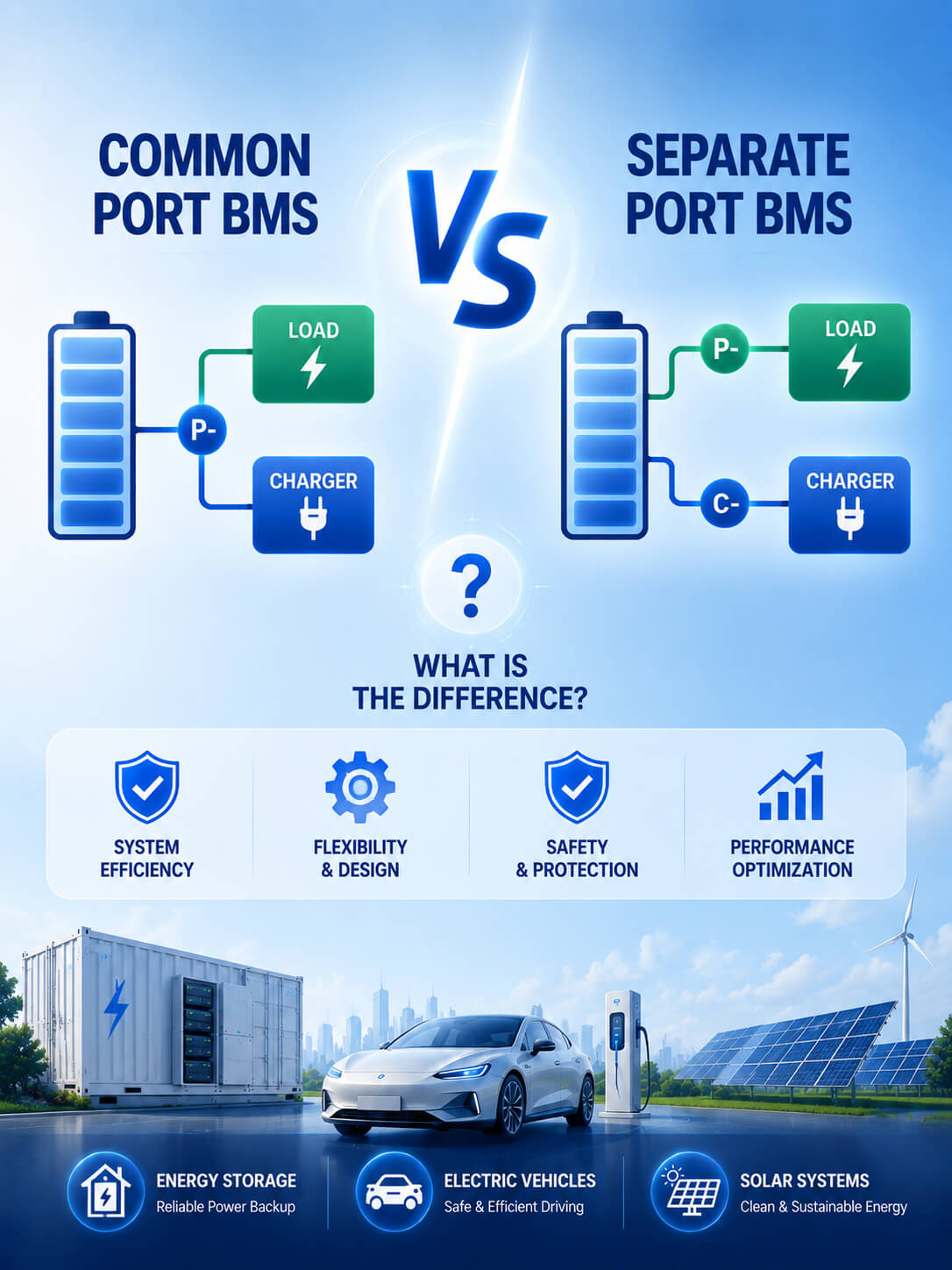
When selecting a Battery Management System (BMS) for a lithium battery pack, one of the most common questions is whether to choose a Common Port BMS or a Separate Port BMS.
Both designs provide essential battery protection functions, but they differ in how charging and discharging currents are managed. Understanding the differences can help you choose the most suitable BMS for your application.
In this article, we will explain how Common Port and Separate Port BMS solutions work and where each type is commonly used.
What Is a Common Port BMS?
A Common Port BMS uses a single negative port for both charging and discharging.
In this design, the charger and load share the same connection point.
Because only one discharge/charge port is required, wiring is relatively simple and installation is convenient.
Advantages of Common Port BMS
- Simpler wiring
- Easier installation
- Fewer external connections
- Lower system complexity
- Suitable for most standard lithium battery applications
Typical Applications
Common Port BMS is widely used in:
- Energy Storage Systems
- E-bikes
- Electric Scooters
- Power Tools
- Portable Energy Systems
- Lead-acid Replacement Batteries
For most users, a Common Port BMS provides a reliable and cost-effective solution.
What Is a Separate Port BMS?
A Separate Port BMS uses independent ports for charging and discharging.
The charger connects to the charging port, while the load connects to the discharge port.
This design allows charging and discharging circuits to be managed separately.
Advantages of Separate Port BMS
- Independent charge and discharge control
- Flexible system design
- Suitable for applications with specific charging requirements
- Convenient for certain industrial battery systems
Typical Applications
Separate Port BMS is commonly used in:
- Custom Battery Packs
- Industrial Equipment
- Specialized Lithium Battery Systems
- Certain Energy Storage Applications
In applications where charging and discharging conditions differ significantly, a Separate Port BMS may be preferred.
Common Port vs Separate Port: Key Differences
Wiring
Common Port BMS:
- One shared port for charging and discharging
- Simpler installation
Separate Port BMS:
- Independent charging and discharging ports
- More wiring required
Installation
Common Port BMS:
- Faster installation
- Easier maintenance
Separate Port BMS:
- More flexible configuration
- Additional wiring considerations
Application
Common Port BMS:
- Most consumer and commercial lithium battery systems
Separate Port BMS:
- Specialized projects and customized battery systems
Which One Should You Choose?
For most lithium battery applications, a Common Port BMS is the preferred choice due to its simple wiring, lower installation complexity, and reliable performance.
A Separate Port BMS may be suitable when independent charge and discharge management is required by the system design.
When selecting a BMS, it is important to consider:
- Battery voltage
- Battery current
- Application requirements
- Charging system design
- Installation environment
The best choice depends on the specific needs of your battery project.
JBD Smart BMS Solutions
JBD provides Smart BMS solutions for a wide range of lithium battery applications.
Available features include:
- Common Port Design
- Bluetooth Monitoring
- UART Communication
- RS485 Communication
- CAN Communication
- Comprehensive Protection Functions
JBD Smart BMS products are widely used in energy storage systems, electric mobility, lead-acid replacement batteries, and intelligent battery applications.
Conclusion
Both Common Port and Separate Port BMS solutions provide effective battery protection and management.
Common Port BMS offers simpler installation and is suitable for most lithium battery systems, while Separate Port BMS provides greater flexibility for specialized applications.
Understanding the differences between these two designs can help ensure that you select the right BMS for your battery pack.
If you are unsure which BMS configuration is best for your application, contact JBD BMS for professional product recommendations and technical support.