
As lithium battery systems become increasingly intelligent, communication functions have become an essential part of modern Battery Management Systems (BMS). Today, Smart BMS solutions not only provide battery protection but also enable real-time monitoring, data exchange, and system integration.
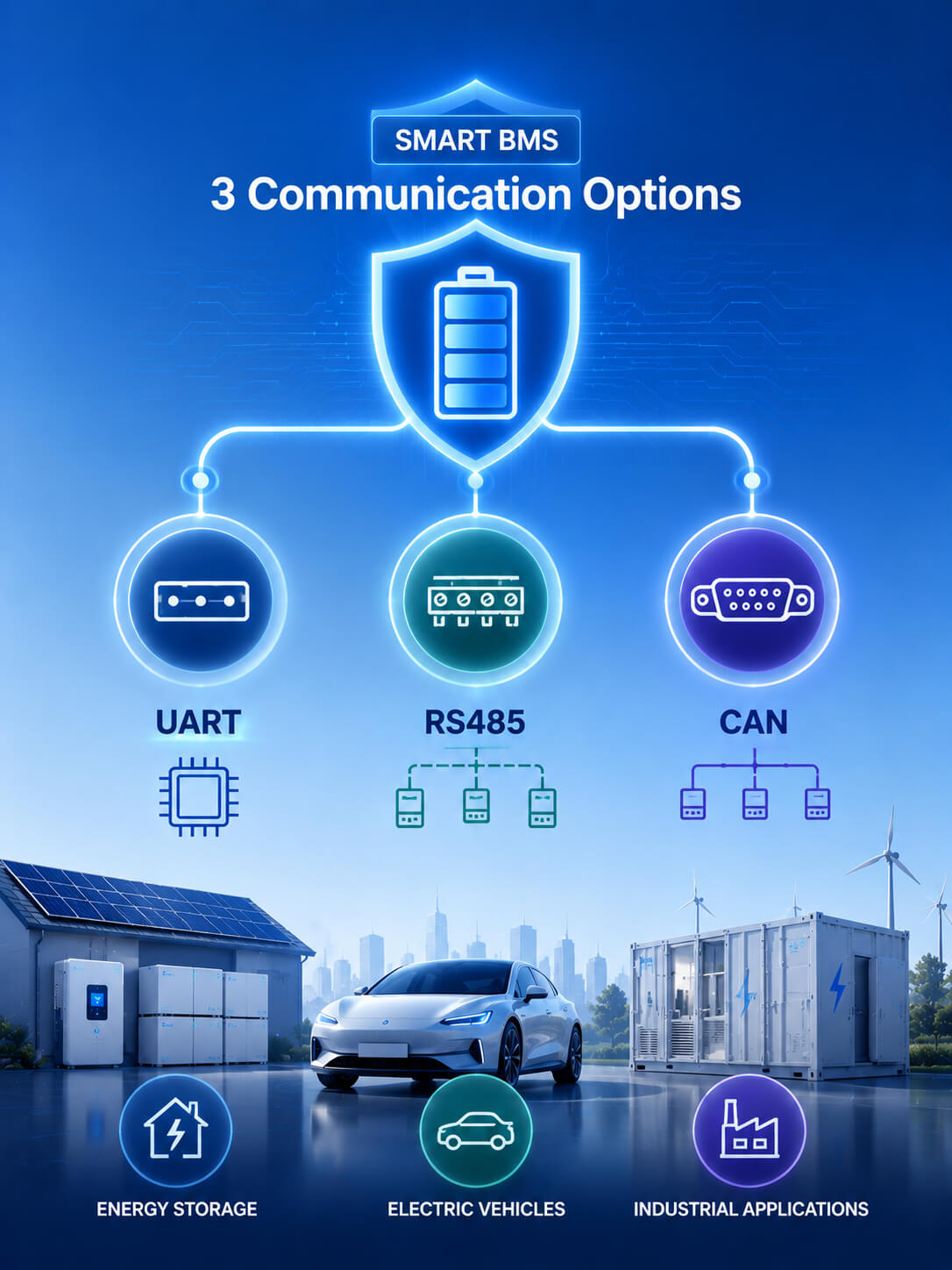
Among the most commonly used communication interfaces in Smart BMS products are UART, RS485, and CAN Bus. Each communication protocol serves a different purpose and is suitable for different applications.
Understanding these communication methods can help users select the right BMS for their battery system.
Why Communication Is Important in a Smart BMS
A traditional BMS mainly focuses on battery protection functions such as overcharge protection, over-discharge protection, overcurrent protection, and temperature protection.
A Smart BMS goes one step further by allowing users to access battery information in real time.
Through communication interfaces, users can monitor:
-
Battery Voltage
-
Cell Voltage
-
Charge and Discharge Current
-
Battery Temperature
-
State of Charge (SOC)
-
Alarm and Protection Status
Communication also enables the battery system to connect with inverters, monitoring platforms, energy management systems, and external controllers.
What Is UART Communication?
UART (Universal Asynchronous Receiver/Transmitter) is one of the most common communication methods used in Smart BMS products.
UART communication is typically used for:
-
PC monitoring software
-
Parameter configuration
-
Firmware upgrades
-
Data reading and diagnostics
Because UART communication is simple and cost-effective, it is widely used during product testing, system commissioning, and technical support.
Advantages of UART
-
Simple connection
-
Stable communication
-
Easy parameter configuration
-
Suitable for battery monitoring software
Typical Applications
-
Lithium battery pack testing
-
Battery parameter setup
-
BMS debugging
-
PC software monitoring
Many JBD Smart BMS products support UART communication for battery configuration and system monitoring.
What Is RS485 Communication?
RS485 is an industrial communication standard designed for long-distance and reliable data transmission.
Compared with UART, RS485 offers better anti-interference performance and can support communication over longer distances.
For this reason, RS485 is widely used in energy storage systems and industrial battery applications.
Advantages of RS485
-
Long communication distance
-
Strong anti-interference capability
-
Stable data transmission
-
Suitable for industrial environments
Typical Applications
-
Home Energy Storage Systems
-
Commercial Energy Storage Systems
-
Solar Battery Systems
-
Industrial Battery Applications
RS485 is often used when multiple devices need to communicate within the same system.
What Is CAN Communication?
CAN (Controller Area Network) is a communication protocol originally developed for automotive applications.
Today, CAN communication is widely used in electric vehicles, energy storage systems, and inverter communication.
Many modern inverters require battery communication through CAN Bus to achieve accurate charging and discharging control.
Advantages of CAN
-
Fast communication speed
-
High reliability
-
Excellent anti-interference performance
-
Supports multiple devices on one network
Typical Applications
-
Energy Storage Systems (ESS)
-
Inverter Communication
-
Electric Vehicles
-
Golf Carts
-
AGV and Robotics
For many energy storage projects, CAN communication is a key requirement when integrating batteries with inverters.
UART vs RS485 vs CAN
Each communication protocol serves a different purpose.
UART
Best for:
-
Battery configuration
-
PC software monitoring
-
Technical debugging
RS485
Best for:
-
Energy storage systems
-
Long-distance communication
-
Industrial applications
CAN
Best for:
-
Inverter communication
-
Electric vehicles
-
Advanced energy storage systems
When selecting a Smart BMS, it is important to consider which communication protocol your application requires.
Communication Solutions from JBD Smart BMS
JBD Smart BMS products support multiple communication interfaces to meet the needs of different applications.
Available communication options include:
-
Bluetooth
-
UART
-
RS485
-
CAN
These communication functions enable users to monitor battery status, configure parameters, and integrate battery systems with external devices.
Whether used in energy storage systems, electric mobility applications, or industrial projects, JBD Smart BMS provides flexible communication solutions for intelligent battery management.
Conclusion
Communication functions have become an essential feature of modern Smart BMS products. UART, RS485, and CAN each provide unique advantages depending on the application requirements.
UART is ideal for battery configuration and monitoring, RS485 is suitable for industrial and energy storage systems, while CAN is widely used for inverter communication and advanced battery integration.
By understanding the differences between these communication protocols, users can select the most suitable Smart BMS for their lithium battery applications.
If you are unsure which communication interface is required for your project, contact JBD BMS for professional technical support and product recommendations.