

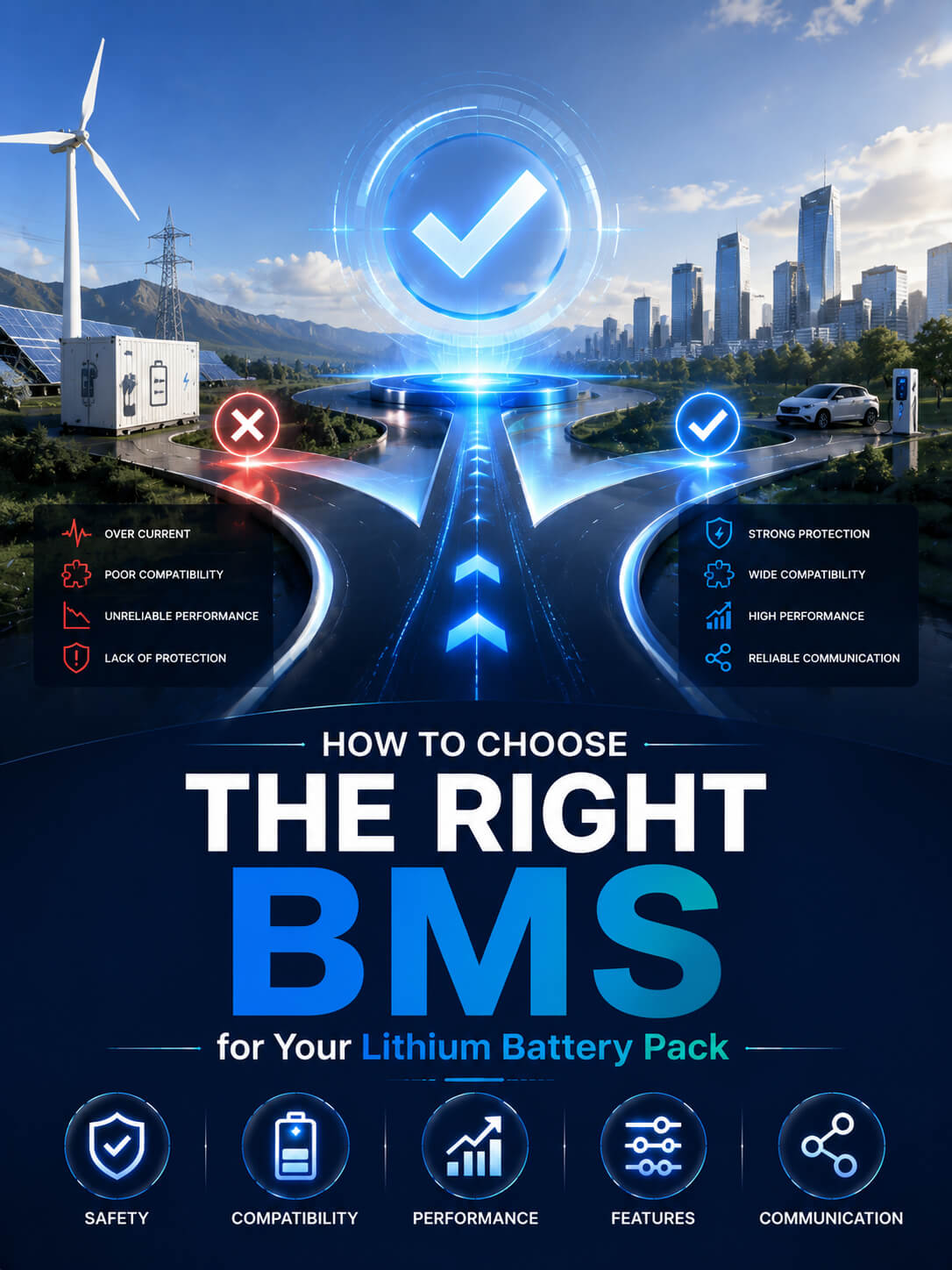
Choosing the right Battery Management System (BMS) is essential for ensuring the safety, performance, and lifespan of a lithium battery pack. Whether you are building an energy storage system, an electric vehicle battery, or a lead-acid replacement battery, selecting the correct BMS can make a significant difference in system reliability.
This guide will help you understand the key factors to consider when choosing a BMS for your lithium battery application.
1. Identify Your Battery Chemistry
The first step is determining the battery chemistry used in your battery pack.
Common battery types include:
- LiFePO4 (Lithium Iron Phosphate)
- Li-ion (NMC)
Different battery chemistries have different voltage characteristics and protection requirements. Therefore, the BMS must be compatible with the battery type you are using.
For example, LiFePO4 batteries are widely used in energy storage systems due to their excellent safety and long cycle life, while Li-ion batteries are commonly used in electric vehicles because of their higher energy density.
2. Select the Correct Series Count
The BMS must match the number of cells connected in series within the battery pack.
Typical examples include:
- 4S LiFePO4 for 12V systems
- 8S LiFePO4 for 24V systems
- 16S LiFePO4 for 48V systems
Choosing the wrong series configuration may result in inaccurate voltage monitoring and protection functions.
Before selecting a BMS, always confirm the battery pack voltage and series count.
3. Determine the Required Current Rating
Current rating is another important factor.
The BMS should support the maximum continuous discharge current required by the application.
For example:
- E-bikes: 20A–50A
- Electric motorcycles: 50A–150A
- Golf carts: 100A–200A
- Energy storage systems: 100A–200A
To improve reliability, many users choose a BMS with a current rating slightly higher than their actual operating current.
This helps reduce heat generation and provides additional safety margin during peak loads.
4. Consider Communication Functions
Modern Smart BMS solutions provide communication features that allow users to monitor battery status in real time.
Popular communication options include:
Bluetooth
Bluetooth allows users to view battery voltage, current, temperature, and other parameters through a mobile application.
UART
UART is commonly used for parameter configuration and PC software monitoring.
RS485
RS485 is widely used in industrial equipment and energy storage systems because of its stable long-distance communication capability.
CAN Bus
CAN communication is often required for inverter integration and electric vehicle applications.
When selecting a BMS, choose the communication interface that matches your system requirements.
5. Check Protection Features
A reliable BMS should provide comprehensive battery protection.
Important protection functions include:
- Overcharge protection
- Over-discharge protection
- Overcurrent protection
- Short-circuit protection
- High-temperature protection
- Low-temperature protection
These functions help prevent battery damage and improve overall system safety.
For demanding applications, additional features such as heating control, relay control, and data logging may also be valuable.
Why Choose JBD Smart BMS?
JBD specializes in intelligent Battery Management Systems for lithium battery applications.
JBD Smart BMS solutions support:
- LiFePO4, Li-ion(NMC) batteries
- Bluetooth monitoring
- UART, RS485, and CAN communication
- Multiple protection functions
- Energy storage systems
- Electric mobility applications
- Lead-acid replacement solutions
With reliable performance and flexible configuration options, JBD BMS products are widely used in energy storage, electric vehicles, AGV systems, robotics, and many other lithium battery applications.
Conclusion
Selecting the right BMS involves evaluating battery chemistry, series count, current rating, communication requirements, and protection functions. A properly matched BMS not only improves battery safety but also enhances system performance and extends battery lifespan.
If you are unsure which BMS model is suitable for your battery pack, contact JBD BMS(cara@jbd-bms.com) for professional selection support and technical guidance.