

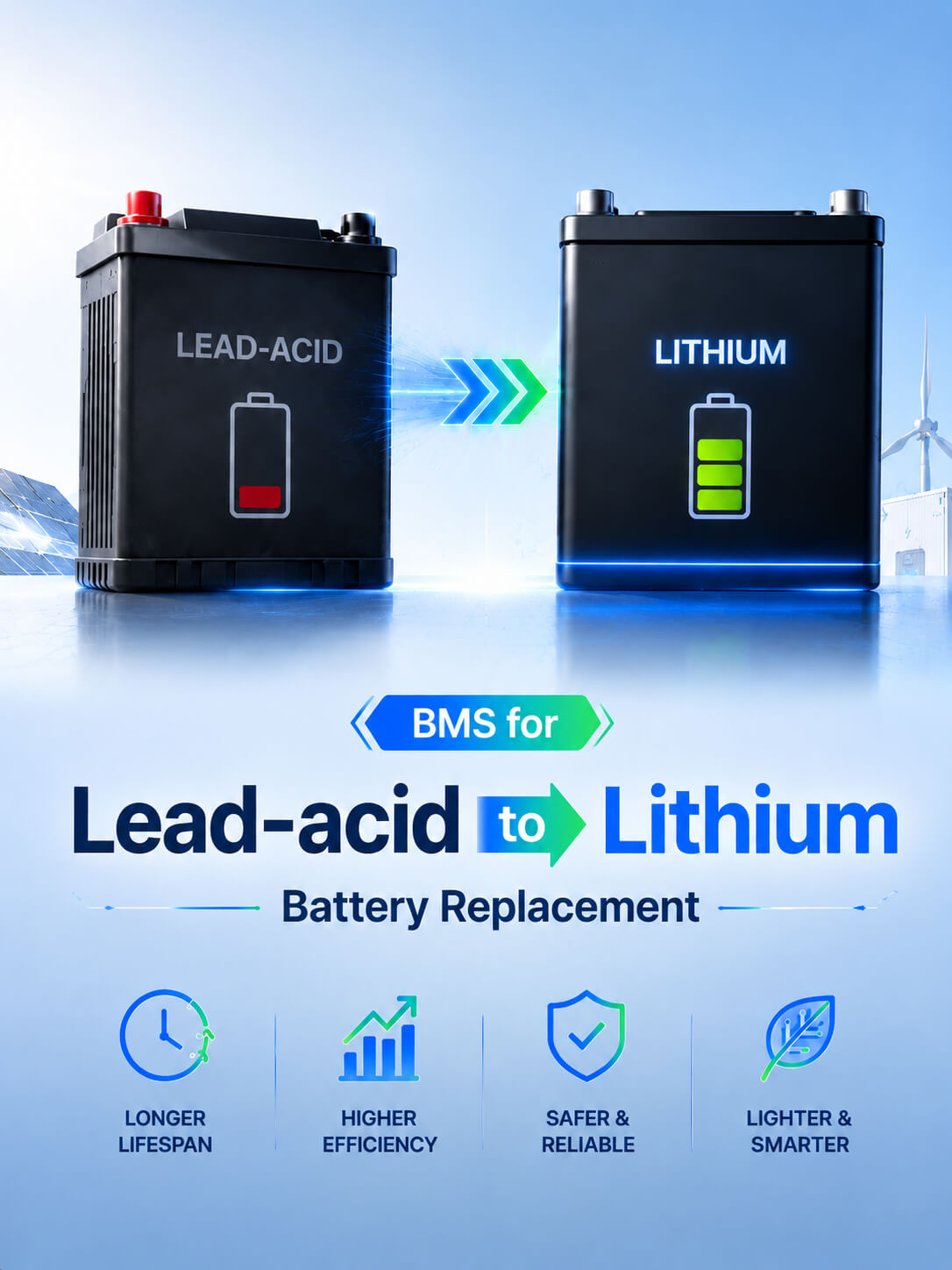
As more people and businesses transition from lead-acid batteries to lithium battery solutions, selecting the right Battery Management System (BMS) has become critical. Lithium batteries offer higher energy density, longer cycle life, and lighter weight, but without a reliable BMS, they can face safety risks, performance issues, and shortened lifespan.
A BMS designed for lead-acid to lithium replacement ensures the battery pack operates safely and efficiently, making the upgrade a smooth and reliable process.
Why Replace Lead-acid Batteries with Lithium?
Lead-acid batteries have been used for decades in cars, RVs, golf carts, marine systems, and backup power. While they are cost-effective and widely available, they have several limitations:
- Lower energy density: Lead-acid batteries are heavier and store less energy per unit weight.
- Shorter lifespan: Typically 300–500 cycles, much less than lithium alternatives.
- Maintenance needs: Regular water topping and equalization are required.
- Voltage drop under load: Lead-acid batteries tend to sag under high current.
Lithium batteries, especially LiFePO4, overcome many of these limitations:
- Higher energy density – lighter and smaller packs for the same energy.
- Longer cycle life – 2000–5000 cycles depending on conditions.
- Maintenance-free – no water or periodic equalization required.
- Stable voltage – minimal voltage drop under high load.
However, lithium batteries require careful management, making a suitable BMS essential.
What Does a BMS Do in a Lead-acid Replacement System?
A Battery Management System protects the lithium battery pack and optimizes its performance. When replacing a lead-acid battery with lithium, the BMS must handle:
- Voltage monitoring: Ensures cells stay within safe voltage ranges to prevent overcharge or over-discharge.
- Current protection: Limits charge and discharge currents to prevent overheating and potential damage.
- Temperature monitoring: Protects the battery from extreme temperatures that may occur in vehicles or storage systems.
- Cell balancing: Ensures all cells in the pack maintain similar voltage, preventing weak cells from degrading overall performance.
- Safety cutoff: Automatically disconnects the battery if unsafe conditions occur.
For lead-acid replacement, the BMS ensures that the lithium pack can safely mimic the voltage and current profile of the original lead-acid battery.
Key Considerations When Choosing a BMS for Lead-acid Replacement
1. Voltage Compatibility
Determine the original lead-acid battery voltage (12V, 24V, or 48V) and ensure the lithium replacement pack and BMS support the same voltage system.
2. Current Rating
The BMS must handle the maximum current that the application requires, including startup currents in vehicles and peak loads in power tools or RVs.
3. Communication Features
While not always necessary, a BMS with monitoring capabilities such as Bluetooth or RS485 can provide real-time data on voltage, current, temperature, and state of charge. This helps with diagnostics and ensures optimal battery performance.
4. Protection Features
Ensure the BMS provides comprehensive protection:
- Over-voltage
- Under-voltage
- Overcurrent
- Short-circuit
- Temperature protection
These protections are critical to avoid damage during aggressive vehicle startup or heavy load operation.
5. Form Factor and Installation
Lead-acid replacement batteries are often designed to fit existing battery trays. The BMS should be compact and integrate easily with the pack without requiring major modifications.
Applications of Lead-acid to Lithium BMS
Automotive Starter Batteries
Replacing car or truck lead-acid batteries with lithium provides lighter weight, consistent voltage, and longer life. A proper BMS ensures safety during high current starts.
Golf Carts and RVs
Lithium upgrades increase runtime and reduce weight. The BMS maintains safety during repeated discharge cycles and ensures proper voltage delivery.
Marine Batteries
Boats benefit from lighter lithium batteries. A BMS protects against overcurrent and temperature extremes common in marine environments.
Backup and Off-grid Systems
Replacing lead-acid batteries in solar or UPS systems with lithium allows higher efficiency and longer service life. The BMS ensures reliable operation for energy storage applications.
Why Choose JBD BMS for Lead-acid Replacement?
JBD specializes in intelligent Battery Management Systems designed for lithium upgrades. Key advantages include:
- Support for 12V and 24V systems
- Comprehensive protection functions for voltage, current, and temperature
- Monitoring and communication via Bluetooth or RS485
- Reliable performance for automotive, RV, marine, and backup applications
- Easy integration into existing battery trays
By choosing JBD Smart BMS, users can confidently upgrade from lead-acid to lithium while ensuring safety, reliability, and extended battery life.
Conclusion
Upgrading from lead-acid to lithium batteries offers significant benefits, including lighter weight, higher energy density, longer lifespan, and lower maintenance. However, to fully realize these advantages, a reliable BMS is essential.
A properly selected BMS ensures safe operation, accurate monitoring, and protection against common battery risks. JBD Smart BMS provides professional solutions for lead-acid replacement applications, making your lithium upgrade simple, safe, and effective.
If you are planning a lead-acid to lithium battery upgrade, contact JBD BMS for guidance and professional BMS selection support.